The Fielding Circle, Explained Without the Jargon
The cricket fielding circle explained: see how its marked inner area shapes fielder positions, opens scoring space and influences limited-overs tactics.
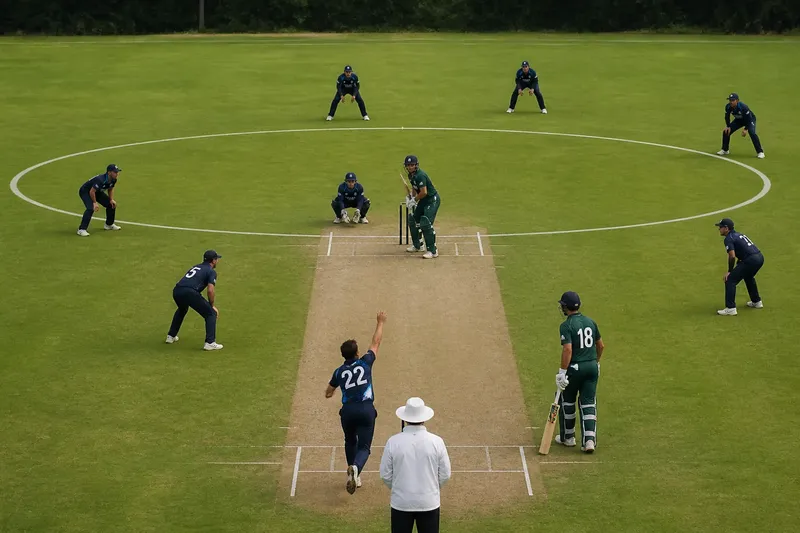
The cricket fielding circle can explain why a batter’s easy single suddenly becomes difficult—or why a lofted shot finds empty grass. In limited-overs cricket, the marked inner area helps set rules for where fielders may stand; it is not a boundary that changes how the ball behaves. Follow one invented over from the captain’s viewpoint and the markings become easier to read.
What does the circle mark on the field?
The fielding circle is a marked area inside the boundary, usually shown by a painted or roped line on the outfield. In limited-overs cricket, fielding restrictions use this inner area to regulate how many fielders can be positioned outside it at particular stages of an innings.
The circle is not the same thing as the pitch, the boundary or a target zone for bowlers. A fielder can stand inside or outside it, but the number allowed outside depends on the format and the phase of the innings. The point of the restriction is to shape the balance between attacking field placements and the batter’s chance to find open space.
For a spectator, the useful question is not whether a fielder is standing on the painted line. Ask instead: how many are outside the circle, and what area of the field does that leave open?
How does the restriction shape the field?
When fewer fielders may patrol the outfield, the captain has to choose which boundaries to protect. Some players may stay close to the batter to stop singles or catch a mistimed shot; others are sent back to guard likely scoring areas. That choice leaves gaps, and the batter can try to use them.
The fielding circle therefore affects both sides. A batter may look for space beyond the inner ring, while a bowler and captain may try to steer the shot towards a more heavily guarded area. The restriction does not dictate a particular field: it makes each placement decision more visible.
Limited-overs formats do not all use identical restrictions, and the rules can distinguish phases of play or types of competition. For a specific match, the playing conditions and umpires’ signals determine the applicable limit.
How does one invented over unfold?
Imagine an invented one-day match in its early overs. The batting side wants to build momentum, and the captain of the fielding side has placed several players close in, with others positioned deep enough to guard likely boundaries. Under the conditions for this imagined match, only a limited number may be outside the circle during this phase.
The opening batter sees a gap at deep cover, but the ball is aimed at the stumps and arrives with little width. Rather than reach for a risky drive, the batter nudges it towards a nearby fielder and runs. That fielder is inside the circle, so the ball is collected quickly; the batters complete only a single.
For the next delivery, the captain shifts a close fielder towards the leg side, anticipating another nudge. The bowler changes the angle, sending the ball wider outside off stump. The batter can now reach it comfortably and drives towards the cover boundary, where the fielding restriction has left open grass. The ball rolls away for a boundary.
The captain responds by moving one of the permitted deep fielders towards cover. That protects the boundary but leaves another part of the outfield less covered. The bowler then targets the batter’s pads; the batter turns the ball behind square, where a close fielder stops it before the batters can take a comfortable second run.
In this invented sequence, the circle has not made one shot automatically safe or dangerous. It has constrained the captain’s choices, encouraged the batter to inspect the gaps, and given the bowler a reason to vary line and angle. The exchange is a small tactical contest: every adjustment changes the space available for the next shot.
What should you watch between deliveries?
Instead of trying to memorise every fielding position, watch for changes and connect them to the previous ball. A captain who sends a fielder back may be guarding a boundary after a clean hit. A bowler who changes the line may be trying to make the batter hit towards a protected area.
- Count the deep fielders: Notice how many are stationed beyond the circle, then consider which boundary areas they cover.
- Look for the open sector: If one side has fewer boundary riders, watch whether the batter tries to steer the ball there.
- Track a fielder’s move: A player shifting from a close-catching position to the outfield can signal a change in the captain’s priority.
- Compare the next two balls: See whether the bowler changes line, pace or angle after the field is adjusted.
- Watch the running option: A close fielder may make a single harder even when the boundary is not threatened.
These observations help explain intent without assuming that every placement has a single meaning. Captains may be responding to the batter, the bowler’s strengths, the state of the match or a combination of them.
What can the fielding circle tell you about tactics?
The circle makes the trade-off between close fielders and boundary protection easier to see. A close player can pressure the batter’s running and may create a catching chance, while a deep fielder can cut off a well-struck shot. Limited-overs restrictions can prevent a captain from loading the boundary with as many players as desired.
That constraint can make placement look like a puzzle. If the captain protects the straight boundary, a gap may appear square of the wicket. If the captain moves a fielder to close that space, another route may open. The batter’s task is to judge the ball as well as the field; a visible gap is useful only if the delivery can be hit there with control.
The bowler is part of the same plan. A field may invite a shot towards a particular region, while the line and length make that shot awkward. If the batter refuses the invitation and takes a single elsewhere, the fielding side may still regard the delivery as a success.
Does the circle rule stay the same throughout an innings?
No. Limited-overs matches can divide an innings into phases with different fielding restrictions. As those phases change, the number of fielders allowed outside the circle may also change, opening or reducing the captain’s options.
Is the circle a physical barrier?
No. It marks the edge of an area used for fielding restrictions; the ball and players are not stopped by the line. Its relevance is where fielders are positioned under the match’s conditions.
Can a fielder stand on the circle line?
The line itself does not create a separate tactical zone, but whether a fielder counts as inside or outside depends on the applicable playing conditions. Umpires judge fielding positions, so a spectator need not infer a breach from a borderline view.
Does a fielding restriction mean the batter must attack?
No. A batter can take singles, defend or wait for a more suitable delivery. The open space may offer a scoring chance, but the ball’s line, length and pace still determine what is sensible.
Why might the captain leave a gap open?
The captain may prefer to protect another area or may expect the bowler to make a shot into that gap difficult. A gap can also tempt a batter into taking a risk, so its presence alone does not show that the field has been poorly set.
How can you read the next field change?
Return to the imagined over. After the boundary through cover, the captain moved a deep fielder into that sector; after the ball was turned behind square, the bowler and captain had another clue about the batter’s preferred scoring areas. The next delivery is not predictable from those clues, but the field now tells you what the defence is trying to discourage.
Use the circle as a map of constraints, not a promise about where the ball will go. First notice the fielders beyond it, then identify the space left open, and finally compare the placement with the bowler’s delivery. The cricket fielding circle is easiest to understand when you watch it as part of that sequence: restriction, adjustment, shot and response.